As I was reading through Sontag’s “Against Interpretation” I felt a strong level of envy towards her. Here she is, excitingly analyzing (among other things) groundbreaking movies in the early 1960s. Being obsessed with 60s and 70s cinema myself, it is difficult for me to fathom that someone truly lived through all of this. It’s a complete reversal of my situation: I dig through old movies looking for gems; while she was absorbing new cinema on a daily basis.
However, what also became evident is that some of the predictions that she made in the mid-Sixties about the direction of cinema did not hold up at all. Even worse is that now sixty years later I am of the opinion that cinema was truly at its highest level in the Sixties and the Seventies. What to her seemed as cinema leaving its (artistic) embryonic stage turned out to actually almost be its peak. The optimism that she had did hold up deep into the 1970s but by the end of the decade its decay already began. From then onward a major shift occurred: Cinema as an art form became cinema as entertainment.
Jaws and Star Wars are often cited as the catalyst for this development in the late 1970s. Cinema as entertainment in itself is not a bad thing. A fun movie is a fun movie. Not everything needs to be serious. But the ripple effect of these movies had completely changed the landscape to almost unrecognizable levels. To generalize a bit the 70s main thematic explorations were either dark and gloomy as seen in The Deer Hunter, Mikey and Nickey, Dog Day Afternoon; or incomprehensibly absurd as seen in Seven beauties, Pink Flamingos, Phantom of the Paradise. The 1980s, on the other hand, almost immediately jumped into a heavy action adventure mixed with practical effects as seen in The Thing, The Fly, Escape from New York, Altered States, Poltergeist, Videodrome, the Blob, and Re-Animator. It needs to be said that I absolutely love these movies but the fact of the matter is that there was a distinct shift towards a more entertaining aspect of cinema during the Eighties.
Side note: the entire symbolic meaning of Videodrome (1983) builds on McLuhan’s critique on media consumerism and modern society.

(David Cronenberg’s Videodrome 1983)
Sontag’s Opinion in the 1990s
Fortunately for me, Sontag did the one thing that kept going through my mind while reading her essays: What did she think in the 80s or 90s about cinema? Sure enough just as I thought that I finished her book she added an afterword titled “Thirty years later…”. Obviously this did not exist in the original release of the book but personally it was my favorite chapter. To no surprise there was a high level of pessimism in her final words. In an almost Mark Fisher Hauntological sense she argues:
“The two poles of distinctively modern sentiment are nostalgia and utopia. Perhaps the most interesting characteristic of the time now labeled the Sixties was that there was so little nostalgia. In that sense, it was indeed a utopian moment.
The world in which these essays were written no longer exist. Instead of a utopian moment, we live in a time which is experienced as the end of every ideal.”
What made the Sixties so special was that the utopian thinking led to instant new artistic inventions. Nostalgia uses the past, utopia looks ahead. As a result she says:
“I thought it normal that there be new masterpieces every month.”

(Nagisa Oshima’s Death By Hanging 1968)
By the time the Eighties arrived nostalgia started to slowly grow in its presence. The Thing, The Fly, and the Blob were remakes from the 1950s while The Terminator and Star Wars became major franchises. Yes, incredibly original cinema was still being created but concurrently when comparing the movies I listed from the 70s with those of the 80s the major difference largely speaking is, in fact, seriousness.
As Sontag later in response to her optimistic arguments she made in her essays from the 1960s writes: “What I didn’t understand was that seriousness itself was in the early stages of losing credibility in the culture at large, and that some of the more transgressive art I was enjoying would reinforce frivolous, merely consumerist transgressions. Thirty years later, the undermining of standards of seriousness is almost complete, with the ascendency of a culture whose most ineligible, persuasive values are drawn from the entertainment industry. Now the very idea of the serious seems quaint, “unrealistic,” to most people…probably unhealthy, too.”
This is DeBordian. So while the Sixties had this utopian moment of artistic seriousness and originality, it was the rise of consumer capitalism which ended up destroying this seriousness. Nothing sells better than familiarity. Generally speaking, if you liked the first Star Wars, you’d probably like the second one too. If you did not know much about cinema but are planning on going to watch a movie would you rather watch a new Star Wars movie or will you spend your money on Mishima: A life in Four Chapters or Wings of Desire?
Guy Debord wrote about the “Society of the Spectacle” in 1967, a mere two years after “Against Interpretation” came out which is interesting because cinema truly was at its peak from 1967 till 1977. So I’m agreeing with his theory while also admitting that cinema as an art form was at its highest level directly after his messianic book came out. The answer, like always, in my opinion, is the rise of neoliberalism starting in the early Eighties. Because yes from a Marxist theoretical perspective DeBord’s arguments on consumer capitalism are valid in the Sixties. But I would also argue that the level of consumerism of the 80s was much more hyperglobalized. Being born in 1931 and thus being 35-36 years old when he released his book. DeBord saw the rise of consumer capitalism develop with his own eyes. He saw the gradual effect the entertainment industry and the invention of the TV was having on the world. But I would also argue that the Society of the Spectacle truly went into hyperdrive in the 80s onward. From that moment onward cinema as entertainment became the dominating way of creating movies. Stakeholders, familiarity, and business ontology.
Funnily enough just as I thought that I finished this blog post I found an essay written by Sontag which essentially confirms albeit not names how neoliberalism is to be blamed for many of the problems that affected cinema in the 1980s.
Sontag wrote a 3-paged essay called “the Decay of Cinema” for the New Yorker on the centennial of cinema in 1996. Firstly, and I did forget to mention this earlier, there has always been a conflict between cinema as an industry and cinema as an art. This is especially the case in the United States up until 1968 with the Hay’s code. When I (and Sontag) talk about how incredible cinema was in the early 60s it wasn’t American cinema that I was talking about. It was French, Italian, Soviet, Swedish, and Japanese. It was only in the late 60s that the US caught up but before that, American cinema was very much still cinema as an industry. The removal of the Hay’s code tipped the scale towards cinema as art in the United States. Movie directors were unchained from restrictions and could now fully experiment. In no time in American cinematic history can a larger change be seen than in 1968. The difference between 1963 to 1968 feels larger than 2005 to 2026. But already from the late 1970s, the industry started winning again and now in 1996, Sontag argued the balance decisively tipped in favor towards cinema as an industry.
She argues that already in the 1970s Hollywood began ‘plagiarising and rendering banal innovations in narrative method and in editing successful new European and ever-marginal independent American films.” which again shows already this profit over art urge American cinema tends to have.
Then the 1980s was the decisive breaking point. For one, there was the catastrophic rise in production costs which changed the industry standards because now a film now had to make a lot of money right away and this favored the blockbuster over the low-budget film. Now why this happened she unfortunately did not explain (but i’ll just blame neoliberalism again). Secondly, “In this country, the lowering of expectations for quality and the inflation of expectations for profit have made it virtually impossible for artistically ambitious American directors, like Francis Ford Coppola and Paul Schrader, to work at their best level.” In other words in the Eighties stakeholders became more powerful as they were seeking profit over artistic expression. Nostalgia over utopia.
She ends it, and I could not have said it better myself: “Cinephilia itself has come
under attack, as something quaint, outmoded, snobbish. For cinephilia implies that films are unique, unrepeatable, magic experiences. Cinephilia tells us that the Hollywood remake of Godard’s “Breathless” cannot be as good as the original. Cinephilia has no role in the era of hyperindustrial films. For cinephilia cannot help, by the very range and eclecticism of its passions, from sponsoring the idea of the film as, first of all, a poetic object; and cannot help from inciting those outside the movie industry, like painters and writers, to want to make films, too. It is precisely this notion that has been defeated. If cinephilia is dead, then movies are dead too . . . no matter how many movies, even very good ones, go on being made. If cinema can be resurrected, it will only be through the birth of a new kind of cine-love.”
Now, in conclusion, what to me is the most depressing is that she wrote this thirty years after “Against Interpretation” came out and I am writing this thirty years after “The Decay of Cinema” was released. All of her arguments are still relevant to this day and have clearly gotten even worse.
On a personal level her arguments have surprised me because they fall precisely within my own personal opinion on cinema. I tend to only watch movies that came out before the 1980s whilst occasionally dabbling into the 90s because the independent wave of the early 90s are excellent. The sole reason for this was mostly just preference. It happened naturally. Post-2005 cinema fully goes digital and the essence that I like so much about it becomes entirely lost. In the 1990s you still had Kieslowski, Twin Peaks, Wong Kar-Wei, and a plethora of Japanese movies. But I would agree that for the most part, cinema as an industry dominates that decade and I therefore tend to mostly watch movies made between the 60s and 70s. So to conclude, I am not sure if I actually envy Sontag. Because just as my dad enough told me last night “it is worse to have something and to lose it, then to never have had it at all”. I am jealous of her for experiencing all the artistic explosion in real time, but I do not envy the bitterness she must’ve felt for seeing it all disappear into soulless entertainment.
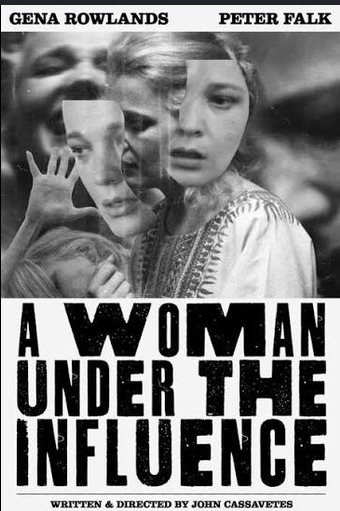
(John Cassavete’s A Woman Under The Influence 1974).