Often what makes a director great can’t be put into words. You just know. The work speaks for itself, in whatever way it is created. There is no formula, either it is incredible or it isn’t. Krzysztof Kieślowski was one of those directors. He was the total package. In my opinion his style is reminiscent of the French New Wave. There is a certain heaviness that is felt when watching his work. As if it is too profound. His thematic ideas focus on a particular philosophy he holds that you can only to a certain extent understand. Therefore, what will follow is essentially me vaguely giving praise to Kieślowski without going fully in depth to what his movies are about because in my opinion his magic truly shines when you stay away from trying to rationalize such a style. You wouldn’t rationalize a painting, you’d just appreciate it for what it is, the same should be done with movies.
My initial interaction with Kieślowski began over a year and a half ago. I watched the Three Colours trilogy and the Double Life of Veronique. In both cases I felt a bit underwhelmed. I did not fully understand what the point was. Similarly to Tarkovsky, the thing with such movie making is that you go in with a sort of expectation that it will be made clear what the movie was about. But in both instances it doesn’t actually happen. That is why this style reminds me of a book. In literature it often isn’t fully made clear what the meaning of everything is, but slowly, over time, gradual changes occur and it becomes evident without there ever being a need to literally highlight the main message of the book. Stylistically the danger with such an approach is that if you are not anticipating this then it can definitely throw you off. Your mind starts wondering elsewhere and because there is no clear indication where you need to look, you don’t realize the nuances of the movie. Another example where this is seen is in Wim Wender’s Perfect Days. The movie almost functions as a documentary. Showcasing the protagonist Hirayama’s day-to-day life is the message. Admittedly this style is a hit or miss for me, because again, when you don’t expect this you end up waiting for a grand reveal that never arrives. The trick therefore lies in finding a way to make this clear without bpointing towards it. Kieślowski and Wender films unfold neatly like chapters in a book, while Tarkovsky’s films seem like a book where half the chapters are missing and way too many pages are dedicated to describing the surroundings. But that is just my opinion.
Anyhow, what made Kieślowski finally click for me was his Dekalog series. Maybe not the first three episodes but by the fourth I began to grasp his style. He tends to have a main idea, a one line sentence, and from that he builds his entire story. Dekalog is based on the decalogue of the Ten Commandments. Hence, you guessed it, every episode is based on one of the commandments. But the same logic can also be applied to the Three Colours trilogy (each color representing an ideal of the French Revolution and the colors of the flag). In Dekalog every episode’s main goal is given away immediately by looking at the title e.g. “Thou shalt not commit adultery” or “Thou shalt not covet thy neighbor’s wife”. Yet what makes this series so astonishing is that it feels deeply philosophical without it being too overwhelmingly deep or cliche. It is the perfect amount where you end up thinking about it for days. I would even argue it would be better to not binge this show and instead watch one episode per week and let it linger for a while. Episode one is a perfect example of this. An immediate hammer gets dropped on the tension between religion and science. Episode six, the “Thou shalt not commit adultery” is nothing short of cinematic perfection. Episode ten is another example of a story that just stuck with me for a long time. To write one memorable story is one thing, to make ten is absurd. Admittedly some episodes are less strong but in its totality Dekalog is perfection.
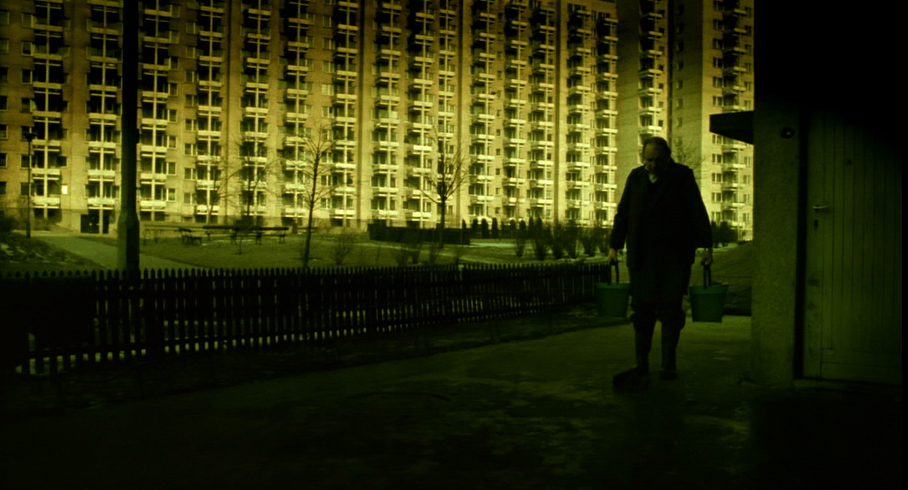
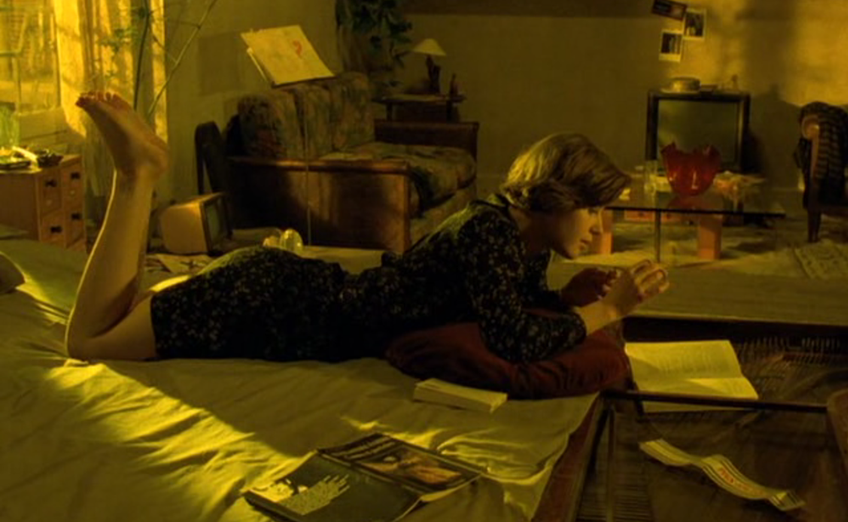
He then brings it up a notch a couple of years later with The Double Life of Veronique. Aesthetically this movie is simply stunning. Reminiscent of Paris,Texas I really do love it when a movie constantly has this green/yellow hue hovering around most scenes. It brings a warmth that really matches with the plot. The marionette scene was beautiful, Irene Jacobs had an all time performance, and his ability to use sound to add another layer of filmmaking is incredibly unique (the tape recordings). The thing is that there is so just much to unpack from this movie and I highly doubt I will ever fully understand it. A.K.A. a classic Kieślowski.

What I find the most interesting is that it never really became clear what the point of the story actually was. I could somewhat understand it, mostly feel it, but so much was left unexplained. But this creates a mystique that often makes the movie more memorable. You can’t solve it, so it remains on your mind for longer. Susan Sontag for instance argued that “the most potent elements in a work of art are, often, its silences”. So after this weird 90 minute double plotline where many things are left explained and nothing is ever really made clear, the only conclusion I could make was that it is genius, a perfect movie. How does that make sense? It doesn’t. That is why I love this movie.
On a broader level I feel confused that such a style cannot be recreated anymore. Grandoliquency does not equate superiority. Firstly, a round of applause to me for creating such an incredible sentence. Secondly, modern cinema favors the spectacle over essentially every other style. This makes sense, but still, from a budgetary and logistical perspective The Double Life of Veronique seems much more easy to make than for instance Dune. Yet The Double Life seems utterly alien to modern movie making. Why? Maybe it is due to shareholder interest (and other things) as I spoke about in my previous blog post. I don’t want to delve into that topic again as that wasn’t the point of this particular blog. Perhaps I should also give even more praise to Kieślowski as ostensibly his greatest skill is that he can do so much with so little. While modern movies tend to do so little while doing so much. The Odyssey for instance was a great experience to see in the cinema but 2 days later, and especially now a month later, not much has stayed with me from that movie. It’s a forgettable film, strangely enough. Human-to-human interactions between normal working class people with some sort of philosophical or religious dilemma that affects them, that is Kieślowski. It is simple but feels significantly larger than most modern movies that aim to be deep. The “Hard work pays off” or “we live in crazy political times” has been done so many times this decade it keeps surprising me how this bottomshelf intellectualism keeps dominating modern cinema. It is shallow and forgettable.
The other day I watched Olivia Wilde’s The Invite and I think that it relates well to my argument. It’s a simple movie. One house, four actors, nothing special. It was great. To my surprise I actually had a lot of fun. The writing was witty and not cliche. It actually just felt like a normal movie. Again, less is more. In a way it kind of seemed a bit like a John Cassavetes film in the sense that an actor who decided to become a director is fully aware that actors love to act and put up great performances. So give them the space to show off their skills. And that is precisely what happened.
Finally, as I was in the process of writing this blog I went to a record store that I haven’t visited in a couple of months. As I was contemplating whether I should buy overpriced DVD’s from Wenders or Fassbender I noticed that on one of the planks they were selling the Dekalog set on VHS. I managed to get it for half the price as the guy working there had no idea what it was but he did manage to mansplain to me that it was for VHS as if I was not aware of that. Whatever, I got a fun room ornament now.
